


Jeet Kune Do vs karate for Street Defense
A comparison of Jeet Kune Do vs karate should start with the question that matters outside the dojo: what will you actually train to do when distance closes, pressure rises, and there is no referee to stop the exchange? Both can build discipline, coordination, confidence, and legitimate fighting skill. The difference is not that one art is automatically effective and the other is not. It is how the school organizes training, what it asks you to practice repeatedly, and whether those methods match your purpose.
For a person seeking practical personal protection, the best choice is usually the school where instruction is honest, consistent, and pressure-tested. A strong karate school can produce a capable martial artist. A well-taught Jeet Kune Do program can do the same. Their priorities, however, often begin from different places.
Jeet Kune Do vs karate: the central difference
Karate is a broad family of Japanese and Okinawan martial arts. Shotokan, Goju-Ryu, Wado-Ryu, Kyokushin, Shorin-Ryu, and many other styles fall under the word karate. Because those systems differ greatly, no single description applies to every karate class. Some schools emphasize traditional forms, basics, rank requirements, and controlled sparring. Others train hard contact, competition, throws, close-range striking, and practical self-defense.
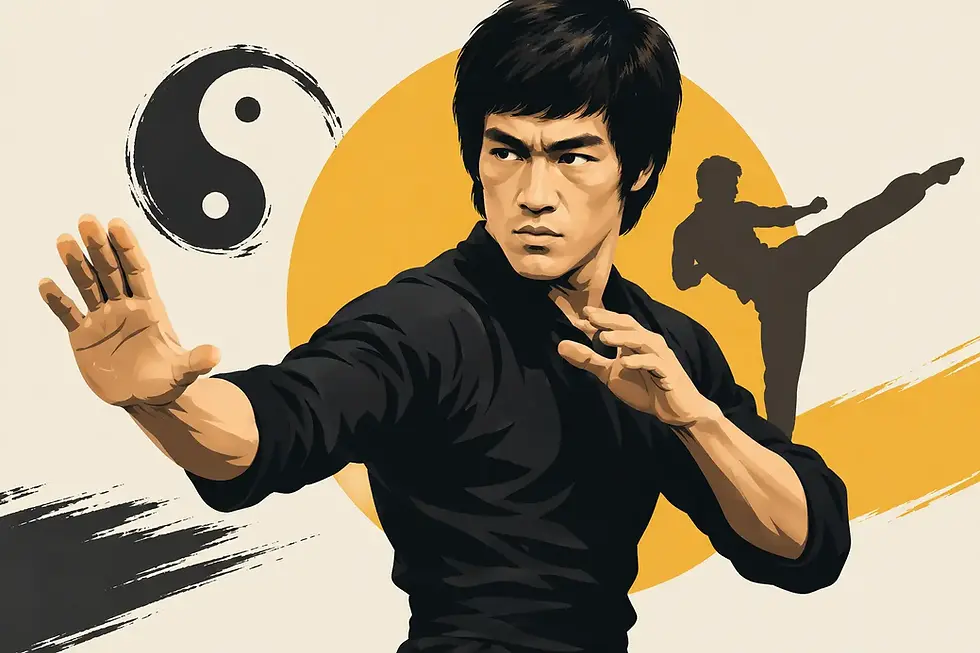
Jeet Kune Do was developed by Bruce Lee with James Yimm Lee as a Chinese-American combat system built around directness, efficiency, combat movement, and personal expression. It is not a collection of techniques selected for appearance. Its purpose is to help the student use what works for their body, range, timing, and situation while discarding what does not serve the moment.
That does not mean Jeet Kune Do is unstructured. Serious JKD requires structure: stance, footwork, interception, striking mechanics, range awareness, partner drills, conditioning, and free sparring. The difference is that the structure is meant to produce functional responses rather than preserve a fixed sequence for its own sake.
Traditional curriculum and functional adaptation
Many karate systems use a clear, formal curriculum. Students commonly learn basic stances, blocks, punches, kicks, kata, partner work, and rank material in a defined order. This can be an excellent learning environment, particularly for beginners and young students. Repetition teaches posture, balance, discipline, attention to detail, and respect for the art's history.
The trade-off is that a student must ask how the curriculum is being applied. A low block, high block, or chambered punch can be useful when understood in context. But practicing a movement in the air is not the same as recognizing a fast, resisting attack. The instructor must bridge that gap through live drilling and realistic partner work.
Jeet Kune Do places adaptation closer to the front of the training process. Instead of asking the student to fit every situation into a prescribed form, it asks practical questions: What is the range? What target is available? Can you move? Can you intercept? Can you hit while protecting yourself from the opponent's response?
This approach often favors economical tools such as the lead straight punch, side kick, low-line kicking, hand immobilization, angular footwork, and combinations that continue only as long as they are needed. JKD training does not require a student to imitate Bruce Lee. It requires the student to understand principles and develop dependable personal tools.
Stance, movement, and striking range
A traditional karate stance may be deeper and more rooted than a typical JKD fighting stance. Deep stances can develop leg strength and teach body alignment. They may also support powerful linear movement and clean technique during basics. In a self-defense setting, however, a very low stance can limit immediate mobility if it becomes the only position a student knows.
Jeet Kune Do generally uses a mobile, on-guard position influenced by fencing, boxing, and Chinese martial arts. The lead hand and lead foot are closer to the opponent, making the nearest weapon available sooner. This supports the JKD idea of interception: stopping or disrupting an attack as it begins rather than waiting to defend after it is fully underway.
Neither approach should be judged by photographs of a stance. Good fighters change posture constantly according to distance, terrain, and threat. What matters is whether training teaches the student to move under pressure, maintain balance after striking, and recover when the first action does not end the problem.
Sparring tells you what the school values
Sparring is one of the clearest ways to see how an art is taught. It develops timing, distance, composure, and the ability to make decisions against a moving person. Without some form of resistance, students can become confident in techniques they have never had to use on someone who is actively trying to avoid or counter them.
Karate sparring varies widely. Point sparring rewards speed, control, clean entries, and scoring awareness. It can sharpen reflexes, but the pauses after a score and limits on follow-up may not resemble a street-defense encounter. Full-contact karate can be physically demanding and develops toughness, though rules may restrict punches to the head or omit certain ranges.
Jeet Kune Do sparring should train the student to apply movement, interception, combinations, and recovery in a more continuous exchange. It is not a license for careless contact. Good instruction progresses safely, using protective equipment, technical control, and matched training partners. The goal is not to prove who is toughest in class. The goal is to build judgment under realistic resistance.
For adults and teens concerned about personal safety, ask a direct question before joining any school: how do students move from cooperative drills to live application? The answer will reveal more than a style name on a sign.
Self-defense is more than winning a fight
Street defense is not sport fighting without gloves. It includes awareness, verbal boundaries, positioning, escape routes, legal judgment, and the discipline to avoid unnecessary confrontation. A physical response may be required, but it should serve the purpose of getting safe, not collecting points or demonstrating a favorite technique.
This is where JKD's emphasis on simplicity can be particularly valuable. Under stress, complicated sequences become difficult to perform. A student needs a small number of high-percentage actions, practiced enough to emerge when fine motor control and perfect timing are absent. Direct footwork, efficient striking, and the ability to create an exit matter.
Karate can also teach these lessons when the instructor deliberately includes realistic scenarios, close-range work, and pressure-based drills. The label alone does not guarantee that training will prepare a student for violence. Some traditional schools address practical defense exceptionally well. Some schools, regardless of style, stop at choreography or competition.
Which art is better for beginners?
A beginner does not need prior athletic experience to start either Jeet Kune Do or karate. The right starting point is a class that teaches fundamentals patiently, maintains standards, and gives students a clear path forward.
Karate may appeal to someone who wants formal progression, traditional customs, and the challenge of kata. It can be an especially good fit for families who value a visible rank system and a consistent classroom structure. JKD may appeal to the student who wants combat movement, functional striking, free sparring, and a curriculum centered on personal protection from the beginning.
Experienced martial artists often find JKD valuable because it challenges habits. A karate practitioner may bring strong kicking, distance management, discipline, and body mechanics to JKD training. In return, JKD can add tools for interception, mobility, non-telegraphic striking, and adapting across ranges. Respect for prior training is appropriate. So is the willingness to test old assumptions.
At Pear Tree Self Defense Center, instruction is grounded in direct Bruce Lee lineage through Original Oakland JKD and L.A. Concepts JKD. That lineage matters because it connects students to a documented body of instruction, but training still has to work on the floor. Students must drill, spar, correct errors, and develop control as well as power.
How to evaluate a school before you enroll
Observe a class if possible. Look beyond uniforms, trophies, and promotional claims. Are students attentive and respectful? Does the instructor correct mechanics with specific detail? Do advanced students demonstrate control around beginners? Is there progressive partner training rather than only solo practice?
You should also ask what the school teaches about avoidance and de-escalation, how it handles sparring safety, and whether instructors can explain why a technique is used. A serious school does not promise invincibility. It teaches responsibility, awareness, conditioning, and practical skill built over time.
The useful choice is not the art with the strongest marketing claim. Choose the training that makes you more alert, more disciplined, and more capable of protecting yourself and those in your care. Then attend consistently enough for that capability to become earned confidence.


Comments