


Efficient Striking Techniques for Street Defense
A strike that looks powerful on a bag can fail under pressure if it takes too long to deliver, leaves the body off balance, or requires perfect range. Efficient striking techniques are built for a different standard: delivering a useful response quickly, from a stable position, while preserving the ability to move, protect yourself, and leave danger behind.
For practical self-defense, the goal is not to trade combinations or prove who can absorb more punishment. The goal is to create an opportunity to disengage. That requires disciplined mechanics, judgment, and training that holds up when distance changes and adrenaline rises.
What Makes a Strike Efficient?
Efficiency is not the same as throwing hard. A strike is efficient when it produces the greatest practical result with the least unnecessary motion. It should travel on a direct line, use the body as a connected unit, and return you to a position from which you can move or respond again.
In Jeet Kune Do, this principle is often described as economy of motion. Do not wind up when a shorter path is available. Do not use three movements when one clear movement will do. Do not commit so heavily that a missed strike puts you in a worse position.
An efficient strike has four working parts: proper distance, sound structure, timing, and recovery. Remove one of these and the technique becomes less dependable. A well-aligned punch thrown from poor range may fall short. A fast strike without recovery may expose the chin or pull the defender off balance. Good training develops all four together.
Distance Decides What Is Available
Many beginners focus on hand position before they understand range. Yet distance determines whether a lead-hand strike, a palm strike, an elbow, a knee, or simple movement away is the correct answer. The wrong technique at the wrong range wastes time.
A lead straight punch is often efficient because it travels from the closest available weapon to the nearest practical target. It does not need a large chamber or a dramatic shoulder turn. From a balanced guard, it can interrupt forward pressure, establish range, or support an exit.
At close range, a long punch may become crowded. This is where compact tools and positional movement matter more than reaching. Elbows, forearm frames, shoulder pressure, and short palm strikes can be useful in training because they require less extension. However, close range is also where grabbing, uneven footing, and multiple threats become more likely. The best answer may be to create space rather than stay engaged.
Efficient Striking Techniques Start With Structure
Structure means the body is organized behind the strike. The feet provide a base, the hips and torso support the line of force, the shoulder stays connected, and the wrist remains aligned. When these pieces work together, a smaller person can strike with greater stability than someone who relies only on arm strength.
This does not mean every strike should be stiff. Excess tension slows the body and drains energy. The body should remain relaxed enough to move quickly, then briefly organized at the moment of contact. The hand returns without delay, the chin stays protected, and the stance remains usable.
For a straight punch, avoid allowing the elbow to flare far away from the intended line. Keep the non-striking hand in a protective position, but do not freeze it into a decorative pose. It may check, guard, frame, or help maintain balance depending on the situation. The key is that each part of the body has a job.
A palm strike follows similar principles. It can be a sensible training option for students who are concerned about hand injury, especially when striking hard surfaces is a possibility. The heel of the palm is supported by the arm structure, but the strike still needs proper body alignment and immediate recovery. A palm strike is not a shortcut around training fundamentals.
Timing Beats Speed Alone
A fast person can still be late. Timing is the ability to recognize when an opening exists and act without hesitation or wasted preparation. In street-defense training, this may mean striking as an aggressor closes distance, disrupting a grab attempt, or using a simple response immediately after creating a protective frame.
The most reliable timing is often interception rather than reaction after the opponent has completed an attack. Jeet Kune Do places strong value on intercepting actions because an opponent in motion may be more exposed and less able to recover. This does not require guessing. It requires repeated practice with controlled partners so students learn visual cues, range, and the rhythm of movement.
Timing also means knowing when not to strike. If there is a clear route to safety, leaving is more efficient than standing in front of a threat. If verbal de-escalation is possible, it is preferable to physical conflict. Physical skills exist for the moment when avoidance and escape are not available, not as a substitute for judgment.
Train the Return, Not Just the Delivery
A common training error is admiring the strike after it lands. In reality, every strike creates a responsibility to recover. The hand must return, the feet must remain under the body, and the eyes must stay aware of the environment.
This is why controlled pad work and free sparring have different but complementary purposes. Pads allow students to develop alignment, combinations, and purposeful power. Sparring exposes problems that pads can hide: reaching, dropping the hands, predictable rhythm, poor footwork, and panic when a partner moves. Neither replaces the other.
A simple drill might begin with a lead-hand strike and an angle step, followed by a return to a protected stance. The lesson is not to memorize a fixed sequence. It is to connect striking with movement. If the opponent advances, changes position, or does not react as expected, the student must remain able to adapt.
Power Without Overcommitment
Power comes from coordinated body mechanics, not from swinging harder. A committed strike can be useful when the moment is correct, but excessive commitment is a liability. If the strike misses, the body may rotate too far, the head may move ahead of the feet, and the defender may be unable to change direction.
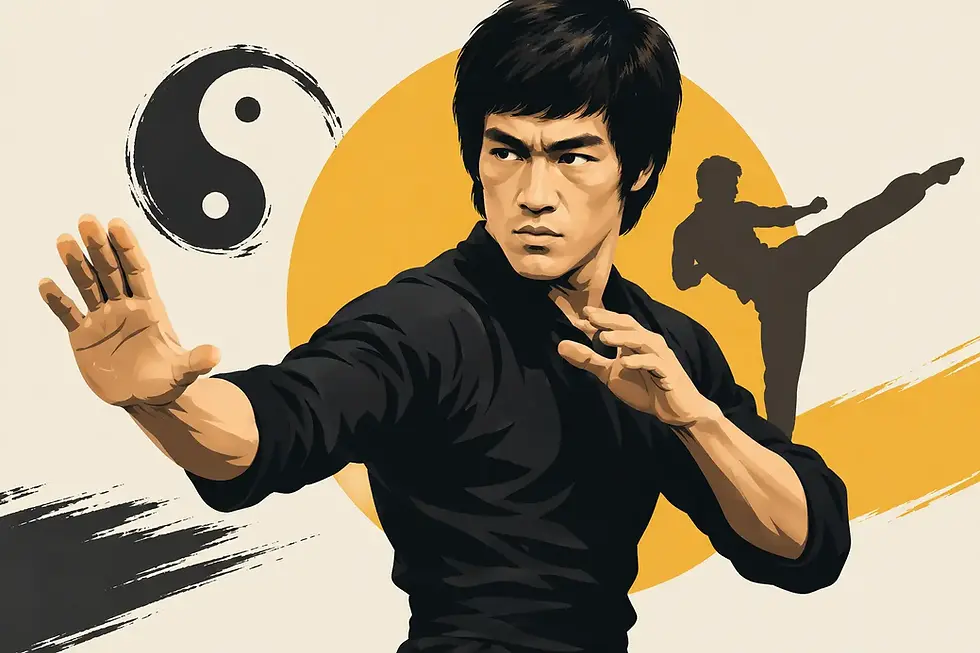
Short, direct strikes often provide a better balance of speed, force, and recovery. This is one reason Bruce Lee's teachings continue to influence practical martial artists. The famous six-inch punch was not a parlor trick about brute strength. It demonstrated how body connection, alignment, timing, and focused intent can generate force through a short distance.
Students should not confuse short motion with careless motion. A compact strike needs disciplined positioning. Train slowly enough to feel where the feet, hips, shoulder, elbow, and hand are aligned. Then increase speed only when the structure stays intact. Speed built on poor mechanics simply makes errors happen faster.
Footwork Is Part of Every Strike
A strike does not begin at the fist. It begins with position. Footwork creates the line, manages distance, and keeps the defender from becoming an easy stationary target. Small adjustments can make a direct strike available while moving the body away from an opponent's strongest line.
Good combat movement is economical. Crossing the feet unnecessarily, taking oversized steps, or bouncing without purpose can disrupt balance. A practical step should either close distance, create distance, change the angle, or improve the ability to exit. If it does none of those things, it may be wasted motion.
This is particularly important for adults who come to martial arts with limited athletic experience. Efficient movement is not reserved for naturally fast people. It can be trained through repetition, awareness, and correct coaching. Young Dragons students benefit from the same foundation in an age-appropriate form: balance, posture, focus, respect for training partners, and the habit of moving with control.
Pressure Testing Builds Honest Skill
Technique must be tested responsibly. A student can look sharp while striking the air, then lose distance and structure when a partner moves unpredictably. Controlled sparring, defensive movement drills, and scenario-based practice reveal what is actually usable.
Pressure testing does not mean reckless contact. It means working with progressive resistance and clear rules. Beginners need time to build safe mechanics. More experienced students need training partners who can challenge timing, range, and decision-making without turning every round into an ego contest.
At Pear Tree Self Defense Center, training in Jeet Kune Do and Li Shu Ziwei Do is centered on functional movement, free sparring, and personal protection rather than empty ceremony. Students are expected to train with focus and respect, because reliable self-defense skill is built through consistent practice, not distraction.
The useful question after any striking drill is simple: did the technique improve your position? If it created distance, protected your balance, disrupted pressure, and gave you a path to safety, it served its purpose. Train for that result patiently. The confidence that matters most is knowing you can stay composed, move with purpose, and make sound decisions when it counts.


Comments